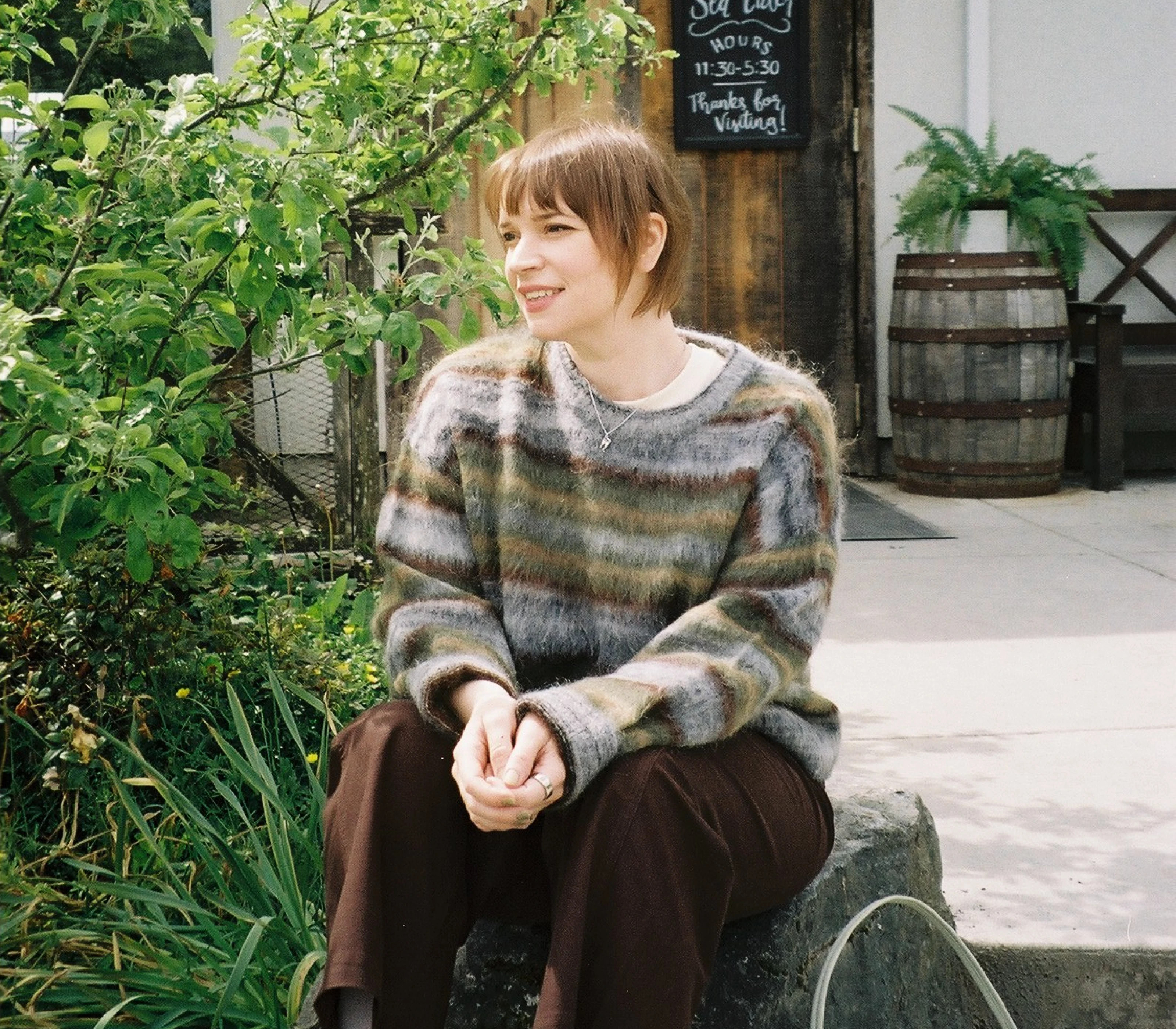
Emily is the Projects Team Lead at Rare Days. She's based in Victoria, works from a home she's slowly wallpapering room by room, and runs on back-to-back meetings from early morning until early afternoon. She reads more than a hundred books a year, does needlework when she needs to actually focus, and thinks project managers should strive to be more like BonziBuddy than Clippy.
What are you listening to right now?
It's a really big summer for the pop girls. The new Olivia Rodrigo singles, and I've had this CMAT album, Euro Country, on repeat in the afternoons when I actually get focused.
I used to not listen to music when I worked, because I have a lot of swirling thoughts and difficulty concentrating to begin with. But if I listen to the same thing on a loop, I can work that into the background and it helps me focus. It's 11 songs, and they're short, so you can get several reps out of it in an afternoon working session.
Where did you grow up, and what kind of kid were you?
Born and raised in Victoria. I grew up in a strict, rule-heavy household. I was terrible at math and struggled in school, running around undiagnosed.
But I was in all of the clubs. Student council, yearbook editor, theater kid. One of the clubs I was in was literally called Leadership, and it was just organizing school dances and car wash fundraisers. That was my first project management job, running a project and organizing that sort of thing. I'd never heard the term project manager back then. It wasn't on my radar at all.
So how did you actually get into it?
Not in a straight line. I studied art history, then did a business degree with a focus on human resources, which seemed like a good non-math path for me. That's where I made my first Gantt chart, but I still wasn't sure project management was a career I could take.
Then a friend from high school reached out. She and her husband ran a little web development shop out of their basement, and they needed help managing social clients and projects. She asked if I had any project management experience. I said, "I've made a couple of Gantt charts in my life, sure, of course I do." I started part time, and eventually I applied to a full-time PM role at a design agency here in Victoria. I got it, and it was a steep, upward learning curve from there.
And how did you come to Rare Days?
A friend of mine was interviewing at Rare Days, and I saw on their website they were hiring a PM. So I emailed them: "Hey, you're interviewing my friend right now. I'd love to be considered too." A couple of interviews, and five and a half years later, here I am.
Five and a half years is a long time to stay at one company these days. What's kept you?
It's the longest I've ever stayed at a job. It comes down to the people, and the degree of autonomy I have over my work. When I started, I was the only project manager for a stretch, and I've always had a high degree of trust from leadership.
It's been a place where I can be authentically me at work. That matters to me. I don't have to mask or put on a front. I get to just show up as myself, do great work, and work on exciting projects with really kind people.
You're in one of the most structured roles at a company built on creative work. How do you think about that tension?
I'd argue project management is a creative role. Every project is different. Every client has a different way of working. The job isn't being a pencil pusher who makes a plan and checks the boxes. It's developing what I call product intimacy: working with clients, understanding how their brains work, how a product can meet their needs, thinking strategically instead of just executing.
You can't deliver good work unless you're deeply entrenched in the project itself. I have one direct report, and I'm always telling him: you have to have product intimacy, or you're not going to be a good project manager. We advocate for the wellbeing of our teams, the budget, the scope, the timeline, the end user. And the way you do that is not on a checklist.
How do you get that product intimacy?
By divorcing yourself from what a project manager looks like on paper. Actively sitting in meetings with designers, understanding how engineering works.
I've always seen the role as three kids in a trench coat: client partnership, product management, and project management, all at once. You have to be all things. You must be that generalist king, queen, non-binary royalty.
A lot of what makes a project manager great is common sense, taste, and an aptitude for pushing things forward. You get people who've got their PMP designation, who've worked at Microsoft, and you put them in a room and they're pencil pushers. They're doing the thing AI will replace them with. If you're the three kids in a trench coat, with an interesting perspective and a strong opinion and a desire to get in the weeds, that's a lot harder to replace.
What does good work mean to you?
Answering questions before they're asked. If I'm preparing a status update for a client, I'm anticipating every question they might have and front-loading the answers, including things they don't yet know they need to know. Thinking ahead, using common sense, being responsive. I don't think it's acceptable to leave someone hanging for more than a day.
And there's a part of the job that's the jester. Do you remember BonziBuddy? That little desktop thing that would sing and tell facts. That's the reference I give people when they ask what my job is like. You have to be BonziBuddy. You sing, you laugh, you tell facts. Because we ask a lot of people. I ask a lot of my engineers, a lot of my clients. If people don't like you and don't want to work with you, you're going to have a hard time getting the extra feature squeezed in. Building goodwill is critical.
The alternative is being Clippy. Nobody likes Clippy.
Outside of work, what are you curious about?
Needlework. It's one of the few times in my life I can genuinely focus, even though my mind still wanders and loops on something else entirely.
The other thing is reading. I love to read, and I wish more people did, because it opens your mind. I think it's critical to read stories written by or about people totally unlike yourself. It's the only way we really foster empathy.
I read two or three books at once, switching between them to keep momentum. My Goodreads goal goes up one book every year. This year it's 113, and I'm about 12 ahead of schedule. I just finished Lena Dunham's memoir Fame Sick, and I'm halfway through a novel called One's Company, which I'd put firmly in the "weird girl literature" camp.