
In today's issue, our VP of Partnerships, Miles, makes amends for his reliance on AI and argues that AI output doesn't delete work, it relocates it onto whoever opens the document.
I made a ten-page PRD in ten seconds and ruined a colleague's afternoon.
Like most people, AI is now part of my daily workflow. And like most people, I'm constantly wrestling with what that means for everything around it: my mental acuity, our team dynamics, my value to the team, the stability of the global economy 😂
Here's the version of that worry I ran into a couple of weeks ago. We'd just come out of a client meeting about a batch of new features. I had the deck we presented, the call transcripts, and the last thirty days of Slack. I fed all of it into Claude and asked for a Product Requirements Document. Ten seconds later I had one, and I felt that little rush AI gives you when you just make a thing.
Then I sent it to a colleague.
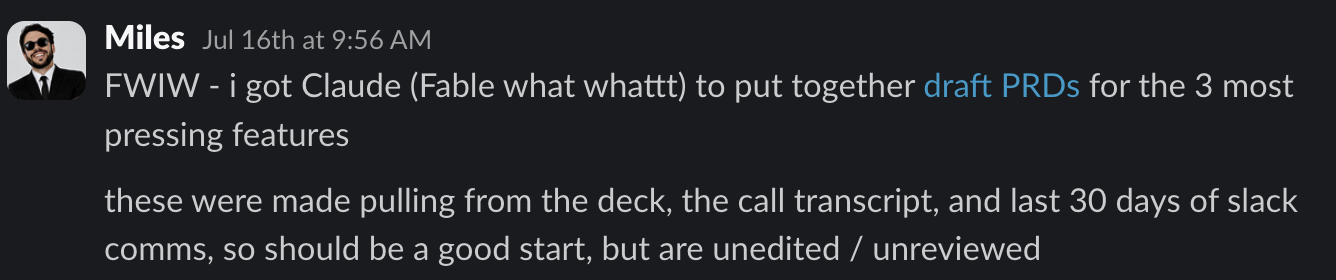
It was a great head start!... for me.
For the people who opened it, it was ten pages of unreviewed context with the useful parts buried somewhere around the middle and no signal about which parts I actually believed.
The thirty minutes I didn't spend doing this properly didn't vanish. They moved, and they landed on somebody else's afternoon.
The burden of comprehension doesn't disappear, it changes hands
An unedited AI document feels like productivity because the ledger only shows one side. I logged ten seconds. My colleague logged twenty minutes, plus the tax of not knowing which parts I'd endorsed and which parts the model invented on the way through.
Send that same document to five people and you've spent an hour and forty minutes of other people's time to save yourself thirty. Whose productivity gain is that, exactly?
I want to be fair to the impulse, because the value here is real. Getting context assembled fast is a win. Getting a rough draft in seconds instead of an hour is a win. The problem isn't the generating, it's the send button: the moment the thing leaves me and becomes somebody else's problem to decode.
The person who should be doing the trimming, the consolidating, and the deciding what's actually useful is the person with the most context. That is always the person who generated it.
Internally it's a fairness problem. Externally it's expensive.
Inside a team you can mostly fix this with a conversation (more on ours in a minute). Outside, it's a different animal, because your audience never agreed to do your editing and has no way to tell you they're doing it other than judging you and tuning you out.
You already know where this turns up: the LinkedIn post that says nothing in four hundred words (or, dear God, the comments 🤦), the support reply that answers a question adjacent to the one you asked, the onboarding sequence where five emails cover the same ground in slightly different words.
Nobody writes in to say "this is slop." They just read a little less carefully next time, and a little less carefully after that, until whatever you make is something they scroll past. When I was in Cannes I talked with people who are leaving AI comments all over LinkedIn, and I couldn't help but judge them for it 🤷
That's the part that makes this expensive. You're spending attention and trust rather than money, and those took years to accumulate.
Our CEO, Tonner, framed it well in our all hands this week: our reputation is worth more than our profitability, and this is the moment to accept some things costing more than they used to. He meant it as guidance for the company, but it works personally too. Every piece of slop you ship is a small withdrawal from an account you can't see the balance of.
But wait, robots don't care if it's slop
The best point on that call came from Shaun, our VP of Engineering: there are now two audiences for any context you produce. One is the machine. One is the person.
For the machine, stop editing. Go nuts. Dump everything: transcripts, Slack history, half-formed thoughts, the abandoned version of the strategy from March. More relevant context makes the output better, and the model doesn't resent your lack of curation (I can't say the same for my colleagues, or for myself).
For the person, the opposite is true. Every sentence they read is a sentence you asked them to read, and they're going to spend that time whether or not it was worth spending.
Same source material, two completely different jobs. Collapsing them is the whole mistake.
The standard we're attempting to enforce, which you're welcome to steal
So what's the actual bar? Someone on our team dropped a line in the Zoom chat that turned out to be the benchmark. Roughly:
If you've read it, you understand it, and it feels cohesive, it's probably fine to share.
That's the bar. It says nothing about word count and it doesn't ban you from generating anything. It just asks that one human go end to end on something before another human is asked to. (Be honest: the last internal AI document you shipped, did you read 100% of it? Word for word?)
In practice that's three moves, none of which take long:
- Read the whole thing. All of it, not the headings. If you catch yourself skimming your own document, that's your answer.
- Cut anything you wouldn't have written yourself. If you wouldn't have written it, you're not prepared to defend it, and you're about to make someone else evaluate it on your behalf.
- Say what you think. One line at the top: here's what this is, here's the part I'm confident about, here's the part I want your eyes on.
Tonner closed the discussion by calling this a tension rather than a rule, which I think is the right frame. Nobody's saying write everything by hand, we're past that. The tension is between velocity and understanding, and the failure mode is a document that arrives fully formed from someone who doesn't fully understand it.
There's a counterargument I have some sympathy for: this is a transitional problem, not a foundational one. Eventually the output gets good enough that the review step stops earning its keep. Probably true. Doesn't feel close.
Where this leaves most of us
If your team adopted AI faster than it adopted any standard for what gets shipped, you're paying for that somewhere. You just can't see the line item, because it's sitting in somebody else's calendar.
So go open the last three things you sent someone that AI helped you write. Read them the way the recipient did: cold, with no memory of what you were trying to say. Then ask whether you'd have been annoyed if that document had landed in your inbox.
Go edit something already.
And if you think I'm wrong about this, that the review step is friction we'll all laugh about in eighteen months, come make the case. Just don't send me a slop response, because I will read it slowly, and all the way through, before judging you.