By Miles Sellyn, VP of Strategy
New month, new build. I’d say we’re so back, but we never left, baby!
For the next four Thursdays I'm going deep on Saidwell, the platform we designed and built for Jefferson Fisher. If you've watched someone calmly take the heat out of an argument in under a minute on your feed from the front seat of his car, that was probably definitely Jefferson. (15 million followers and a NYT bestseller. The man is reaaaaalllll good at talking.)
What you’ll find below:
- Why a clear brief can still be too big
- The word Shane won't let us use. Who is Shane? READ ON
- What we cut from V1 (including something I spent all of September telling you to build)
- 3 questions that shrink a clear brief
Nothing was wrong with the brief
Most agency stories start with the client asking for the “wrong thing”. This one doesn't.
Jefferson's earlier products lived on platforms he didn't own. His team wanted one place that was theirs for the long term and could house their short-term ambitions: a premium course, a new visual identity, a communication assessment, an AI chat, workbooks, and maybe a community.

Early on, I asked Shane, one of our tremendous Design Directors here at Rare Days, what Jefferson needed that he didn't ask for. He didn't have an answer, and he seemed pretty happy about that!
"There wasn't really anything we discovered where we said, 'You should be doing this instead.'"
So, great. Design it, build it, ship it? That's the version a typical agency would run.
Here's the catch. A brief can be completely right about what you want and still describe more than you can launch well. Every item on Jefferson's list was a good idea. All of them, together, within 60 days, was a different question.
The word Shane wouldn’t let us use
The obvious move is to call it an MVP and start cutting. Shane pushed back on that:
"'Minimum' is the wrong word. It's: what's the most focused thing we could do to communicate the idea of what Saidwell is really well."
Minimum is about what you can get away with. Shane cared about which parts had to be great on day one.
So in the first two or three weeks we turned the brief into a product map and an outline of every key screen, from checkout to the course player. Jefferson's team signed off on that outline before anyone built anything.

Then we pushed. A very long course got compacted. The assessment shrank in terms of interactivity and focused on utility. Everything else got sorted into V1 and V2.
What didn't make V1
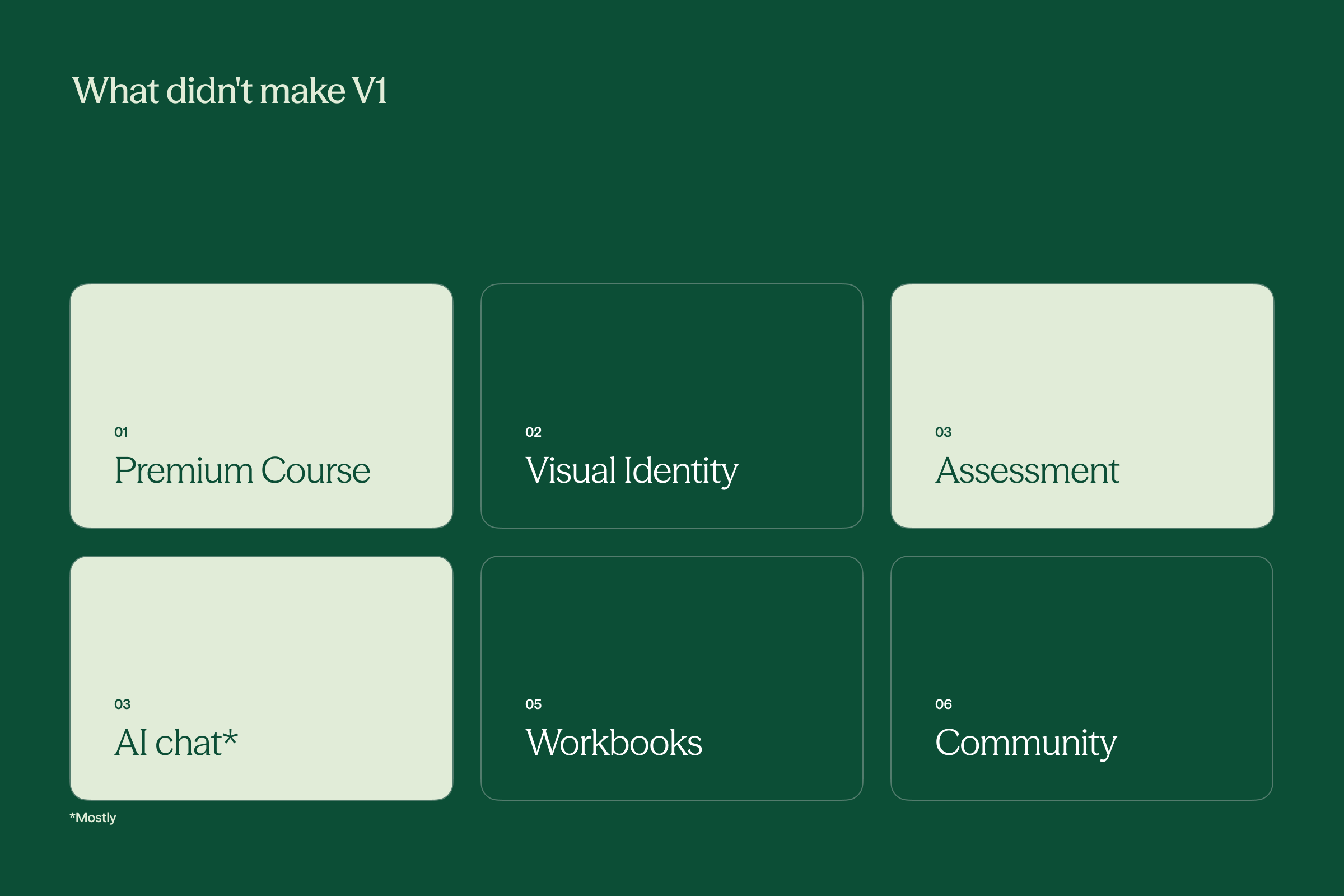
Community. Yes, after I spent all of September on building community with beehiiv! What can I say, I am a rich tapestry of a human being. This one came straight from Jefferson's team early on as we explored the product. They'd run a community before. It ate time, and Jefferson wasn't in there day to day. Their rule for launch: nothing that needs moderation. So community moved out of V1 entirely.
Personalization by type. The plan was assessment first, then course, and eventually your communication type would shape what you see. But at kickoff the types didn't exist yet. Building a personalized path on top of a framework that's still being written is how you end up building it twice. Pushed to V2.
The AI chat, mostly. It made V1, but with one narrow job: help people find the right part of the course. That's it.
The one thing that couldn't move was the mandate Jefferson's team gave us at kickoff for what day one had to deliver: someone can take the assessment and complete the course. Everything got measured against that.
3 questions that shrink a clear brief
- What does a customer have to be able to do on day one? Get it to one sentence. Saidwell's was "take the assessment and complete the course." Anything that doesn't serve that sentence is a V2 candidate.
- What needs a person to keep it running? Community needs moderators. Moderators need time. If nobody on your team has that time, it's not a launch feature (it’s a future job posting).
- What depends on something that doesn't exist yet? Personalization depended on types that weren't written. Build the dependency first and the thing on top of it second.
Shane's version of all this is shorter than mine, but he doesn’t write newsletters:
"Where we pushed back was on trying to do less - what we were aiming towards was doing the focused bit and doing that well."
That's it for today. If you're sitting on a perfectly clear brief, hit reply and tell me what's on it. I'll tell you what I'd move to V2. Fight me!